
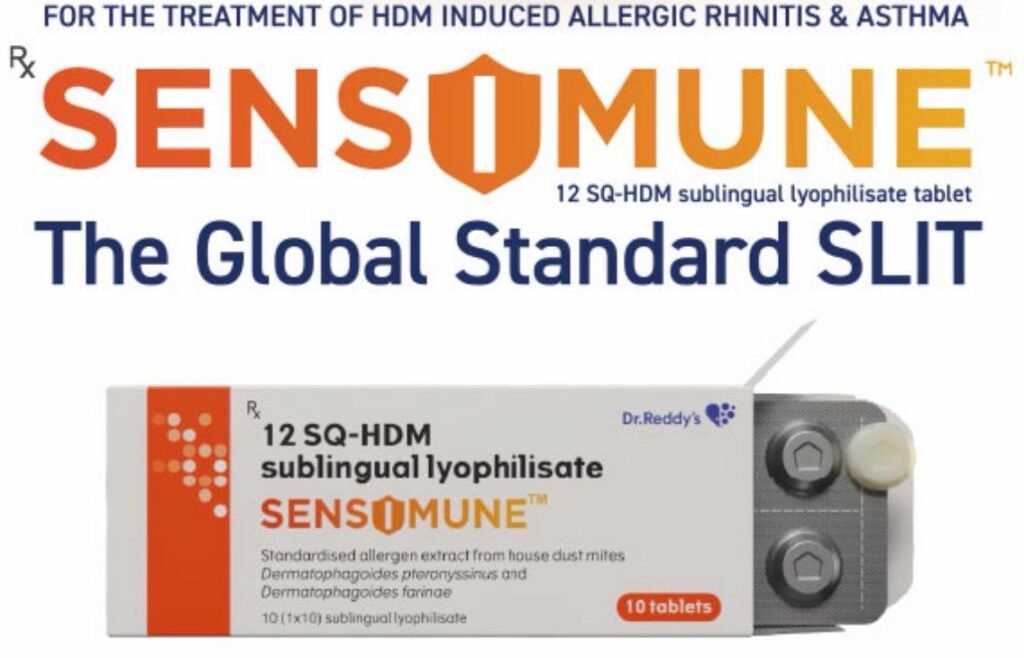
Sensimmune : New Hope For Dust Mite Allergy Patients’s
Sensimmune is a sublingual immunotherapy approved for house dust mite allergy.
What’s the Mechanism: Biomimetic Nanoparticles
Sensimmune’s technology is based on antigen-specific immune modulation.
Traditional immunotherapy (AIT) involves repetitive exposure to high doses of allergens to desensitize the patient.
Sensimmune refines this using nanotechnology:
- Targeted Delivery: HDM allergens (such as Der p 1 and Der p 2) are encapsulated or conjugated with nanoparticles.
- Stealth Internalization: These nanoparticles are designed to be "invisible" to inflammatory pathways. They are internalized by Antigen Presenting Cells (APCs), specifically tolerogenic Dendritic Cells, via pathways like endocytosis.
- T-Cell Retraining: Instead of triggering a Th2-mediated allergic response (IgE production), the technology promotes a Th1 or Regulatory T-cell (Treg) response. This leads to the secretion of anti-inflammatory cytokines like IL-10 and TGF-β.
2. Clinical Advantages over Traditional AIT While standard sublingual (SLIT) or subcutaneous (SCIT) immunotherapies are effective, they often require 3–5 years of treatment and carry risks of local or systemic reactions. Sensimmune aims to improve this via:
- Higher Precision: Nanoparticles allow for a lower effective dose of the antigen while achieving superior immune modulation.
- Reduced Side Effects: By shielding the allergen from mast cells and basophils, the risk of anaphylactic or severe local reactions is significantly lowered.
- Faster Induction: Scientific models suggest that nanoparticle-mediated delivery can induce immune tolerance more rapidly than traditional methods.